Every Austin foundation repair starts with the ground under the house, and in Austin that ground changes at I-35*. East of the highway it’s deep expansive Blackland Prairie clay; west of it, thin soil over Edwards Plateau limestone.
The soil, plasticity index, and foundation type change from one neighborhood to the next. See what’s under your ZIP and what a repair usually takes.
* I-35 is Interstate 35: The major highway that runs north–south straight through the middle of Austin (and up through Waco, Dallas, and down to San Antonio).
Overview
- Dominant soil: Blackland clay east of I-35*, thin soil over limestone to the west
- Annual rainfall (1991–2020): 35.8″ – seasonal swing 3.2″
- Monthly swing: 5.1″ → 1.9″ (May vs July)

Austin foundation repair by ZIP
| ZIP | Neighborhood / area | Characteristic soil | PI | Shrink-swell | Foundation |
| 78660 | Pflugerville | Houston Black | ~35–50 | Very High | Slab |
| 78724 | Austin (Northeast / Colony Park) | Houston Black | ~35–50 | Very High | Mixed |
| 78744 | Austin (Southeast / McKinney) | Heiden | ~35–45 | Very High | Mixed |
| 78725 | Austin (Far East / Hornsby Bend) | Ferris | ~30–45 | Very High | Slab |
| 78702 | Austin (East Austin) | Houston Black | ~35–50 | Very High | Pier-and-beam / mixed |
| 78741 | Austin (Riverside / Montopolis) | Heiden | ~35–45 | Very High | Mixed |
| 78704 | Austin (South Congress / Zilker) | Houston Black | ~35–50 | Very High | Pier-and-beam / mixed |
| 78745 | Austin (South / Cherry Creek) | Tarrant | ~20–35 | Moderate to High | Mixed |
| 78749 | Austin (Southwest / Circle C) | Tarrant | ~20–35 | Moderate to High | Slab |
| 78735 | Austin (Southwest / Barton Creek) | Brackett | ~10–20 | Low to Moderate | Slab |
| 78732 | Austin (Steiner Ranch) | Brackett | ~10–20 | Low to Moderate | Slab |
| 78730 | Austin (Northwest Hills / River Place) | Volente | ~15–25 | Moderate | Mixed |
Austin Soil Types
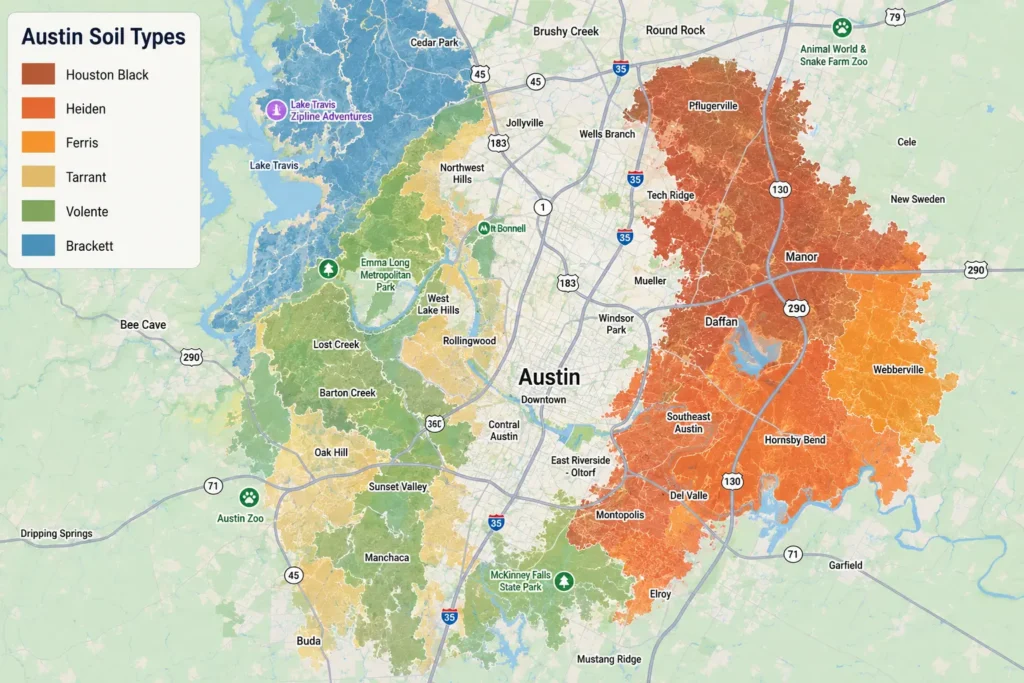
Austin is really two cities underground, split by I-35. To the east, homes sit on deep expansive Blackland Prairie clay that swells and shrinks with every wet and dry spell.
To the west, the Edwards Plateau takes over: thin soil over solid limestone, where the problem is less about clay and more about shallow rock and drainage.
Here’s what’s under your neighborhood, from the most reactive clay to the mildest ground:
- Houston Black – The Texas state soil and the classic “black gumbo.” A deep expansive clay east of I-35 that swells and shrinks hard with the seasons, cracking wide when dry. Common under Pflugerville, East Austin, and the Northeast.
- Heiden — Another deep east-side clay, weathered from mudstone. Very sticky and very plastic, it moves nearly as much as Houston Black. Found around Southeast Austin, Riverside, and Montopolis.
- Ferris – A clayey soil on the eroded slopes east of the city. Strongly expansive, much like Houston Black. Typical of the far east near Hornsby Bend.
- Tarrant – West of I-35 the story flips: Tarrant is a very shallow, rocky clay sitting right on limestone. The clay is reactive, but there’s little of it before you hit rock, so movement is smaller and more about the bedrock than the clay. Common in Southwest Austin.
- Volente – A deeper loamy soil in the western valleys and footslopes. Moderate movement, and generally better to build on than the thin rocky soils around it. Found in Northwest Hills and River Place.
- Brackett – A shallow loamy soil over fractured limestone on the plateau. Low clay content means little swelling, but the soil is thin, so foundations rest close to rock. Common around Barton Creek and Steiner Ranch.
Why Do Austin Foundations Move?
The reason Austin foundation repair is so common comes down to what’s beneath the slab, and in Austin, that depends entirely on which side of I-35 you’re on.
East of the highway, homes rest on the Blackland Prairie: deep smectitic clays like Houston Black (the official Texas state soil) and Heiden, with plasticity indices around ~35–50 and very high shrink-swell potential. This clay swells when wet and contracts when dry, pushing on foundations year after year.
West of I-35, the Edwards Plateau takes over. Soils like Tarrant and Brackett are thin and sit directly on limestone. There’s far less clay to move, so the problem shifts from expansion to shallow bearing, differential settlement, and drainage off the rock.
Either way, Austin’s rainfall drives the cycle. The city averages about 35.8″ of rain a year, but it arrives unevenly: roughly 5.1″ in May against 1.9″ in July. That 3.2″ seasonal swing is what works the soil and, over time, the foundation.
Need Austin Foundation Repair?
Free, no-obligation evaluation from a local G.L. Hunt specialist. · Call Now!
Not in Austin? We break down the soil and foundation risk by neighborhood in Waco and San Antonio too.
Austin Foundation Repair FAQ
What type of soil does Austin have?
Two kinds, split by I-35: sticky clay that swells and shrinks on the east side, and thin soil over rock on the west. The clay side moves more.
What type of soil is best for foundation?
Sandy, well-draining soil. It stays put when it rains, so the foundation stays put too. Clay is the worst because it swells and shrinks.
How to fix soil coming away from foundation in North Texas?
The gap means dry clay is pulling back. Water along the foundation slowly and regularly to keep the soil from shrinking. Don’t just fill the gap with dirt. If the house is cracking too, have it checked.
Sources: USDA-NRCS Official Series Descriptions & KSSL lab data (via UC Davis SoilWeb); NOAA 1991–2020 rainfall normals for Austin (Camp Mabry / Bergstrom). Soil series is characteristic per the Travis County soil survey and the I-35 / Balcones Escarpment split, not a parcel-level measurement; foundation type is by neighborhood construction era.