Managing Water Across Texas Properties
Texas puts commercial properties through intense storm events, long dry spells, and clay soils that swell and shrink as moisture changes. When water repeatedly concentrates near a structure, that cycle can drive movement in foundations and slabs.
G.L. Hunt Commercial reads drainage as part of the structural picture — because solving the foundation problem without solving the water problem just means doing the foundation work twice.
When Drainage Problems Affect The Structure
When water is part of the problem, repairing the foundation without correcting the drainage can mean revisiting the same issue later.
That is why G.L. Hunt reviews drainage conditions when evaluating structural movement. A foundation crack, wet crawl space or settled slab may be connected to the way roof runoff and surface water move across the property.
Commercial Drainage Systems For Texas Properties
The recommended drainage system depends on the source, route and location of the water.
G.L. Hunt’s commercial drainage capabilities include:
- French drains
- Surface drains
- Sump pumps
- Downspout extensions
- Commercial gutter installation and repair
The team may also coordinate drainage work around foundations, crawl spaces and exterior slabs when site conditions connect those areas.
A surface drain used to capture water in a low area serves a different purpose than a French drain designed to manage subsurface moisture, so the system must be matched to the confirmed site conditions.
Signs A Commercial Property May Need Drainage Work
Request a drainage assessment when:
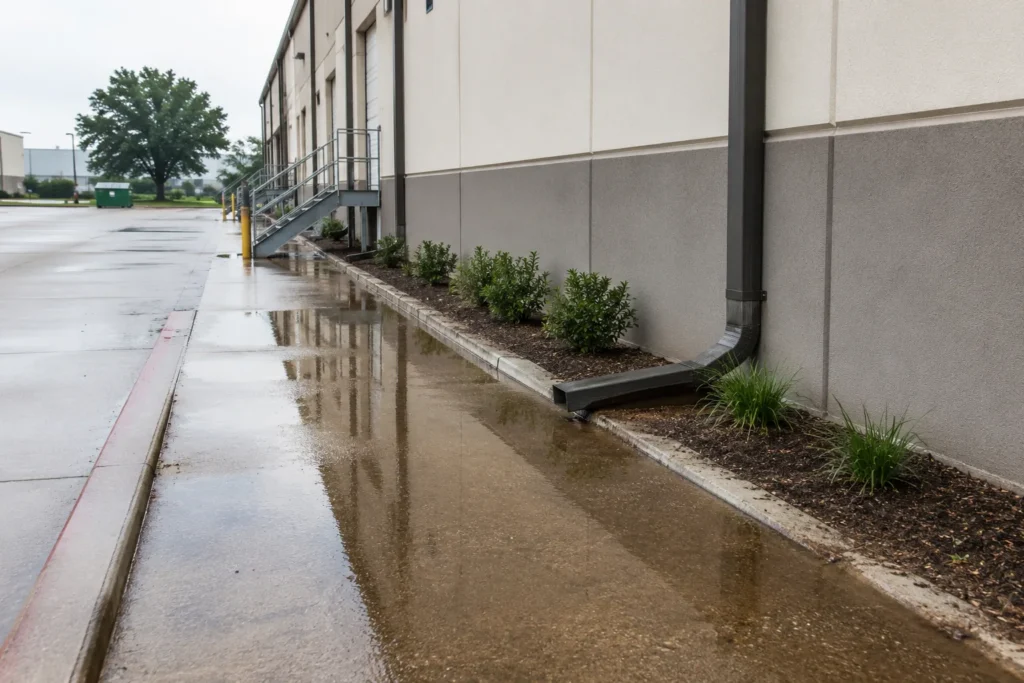
- Water collects near the foundation after rainfall
- Parking or pedestrian areas drain toward the building
- Gutters overflow or downspouts release water beside the structure
- Soil erosion appears near slab edges
- Water repeatedly enters a crawl space
- Interior moisture appears near exterior walls or lower-level areas
- Foundation movement continues after structural work
- Existing surface drains no longer clear water effectively
These signs show where water is appearing. The assessment looks at how grading, roof drainage and subsurface conditions may be directing water toward the affected area.
Addressing The Source And Path Of Water
Commercial drainage work is intended to manage both where water originates and how it moves across the property. That may involve roof runoff concentrating near the foundation, surface water flowing toward occupied buildings or low areas that continue to hold water after storms.
The scope may also address moisture below pier-and-beam structures, erosion near slabs and exterior concrete or gutters, drains and discharge points that no longer direct water effectively.
For multi-property operators, the same assessment approach can help evaluate recurring drainage conditions across several locations.
When water appears to be contributing to foundation movement, the drainage plan may need to coordinate with commercial foundation repair. Moisture beneath an elevated building may also call for commercial crawl space remediation.
A Whole-Property Drainage Assessment
1. Review The Water Pattern
G.L. Hunt reviews where water appears to enter the site, where it collects and how it moves around the building.
2. Inspect Existing Drainage Components
The team reviews relevant gutters, downspouts, surface drains, sump pumps and drainage paths for visible gaps or performance concerns.
3. Consider Structural Conditions
Drainage findings are evaluated alongside visible foundation, slab or crawl space concerns. This helps determine whether water may be contributing to the condition or whether it appears to be an isolated maintenance issue.
4. Develop The Drainage Scope
The proposed work is based on the observed source and route of the water. Depending on the property, the plan may combine several drainage components rather than rely on a single product.
5. Complete And Review The Work
G.L. Hunt’s crews complete the approved drainage work and review the finished installation.
Why A Systems Approach Matters
Moving water away from one low spot does not necessarily correct the broader drainage pattern. Commercial properties may require coordination between roof drainage, surface collection and the soils surrounding the structure.
G.L. Hunt considers those conditions together so the proposed system responds to the observed water pattern and fits the property’s broader structural plan.
This approach also gives commercial clients one point of contact when several drainage components or multiple properties need to be coordinated.
What Affects Commercial Drainage Project Cost?
Commercial drainage pricing depends on the confirmed conditions and proposed system. The source, extent and route of the water, the length and type of drainage components and the condition of existing gutters, downspouts or drains can all affect the scope.
Excavation, site access and where collected water can be directed may also influence the work. Larger properties or multi-building sites may require coordination across several affected areas, while active facilities may need a plan that accounts for restricted access or phased work.
When drainage is tied to foundation or crawl space concerns, the project may also require coordination with those related scopes. A commercial assessment helps define the drainage concern before a system is recommended.
G.L. Hunt coordinates drainage, foundation, concrete and crawl space work within the same company rather than treating them as unrelated property concerns.
Commercial Coverage Across Texas
G.L. Hunt coordinates drainage, foundation, concrete and crawl space work within the same company rather than treating them as unrelated property concerns — with one point of contact when several components or several properties are involved.
Request A Free Commercial Drainage Assessment
If water keeps ending up where it shouldn’t, an assessment traces where it starts, where it’s going and what it’s doing to the structure along the way. Request a Free Commercial Assessment to determine the best next step for the property’s drainage needs.
Commercial Drainage Questions
Can Drainage Problems Affect A Commercial Foundation?
Yes. Repeated water concentration and changes in soil moisture can contribute to foundation and slab movement. The assessment helps determine whether drainage may be contributing to the structural condition.
Is Drainage Evaluated Separately From Foundation Movement?
Not always. G.L. Hunt reviews drainage within the broader structural picture when water may be contributing to foundation, slab or crawl space conditions.
Related Articles
For more expert information about your foundation, crawl space and drainage needs, check out our helpful articles!