
Poly Foam vs. Piers: A Complete Guide For You
It usually starts small. A hairline crack creeping up the drywall near a doorway. A section of driveway that has quietly dropped half an inch below the rest. A kitchen tile that rocks under your foot. Individually, none of it seems urgent. Together, it’s enough to make you wonder what’s really going on underneath your house.
So you start researching. And almost immediately, you run into competing answers. One company swears by poly foam. Another says piers are the only real fix. A third throws around terms like polyjacking and mudjacking without explaining the difference.
Here’s the honest answer most companies won’t lead with: there is no single “best” foundation repair method. There’s only the right method for your specific problem.
Pouring poly foam under a home that’s structurally settling is a waste of money. Driving piers under a sunken sidewalk is overkill. The trick is knowing which situation you’re actually in.
This guide walks you through both methods, where each one wins, and a simple decision tree to help you self-qualify before you ever pick up the phone.
The Two Methods, Plainly Explained
What Is Poly Foam (Polyjacking)?
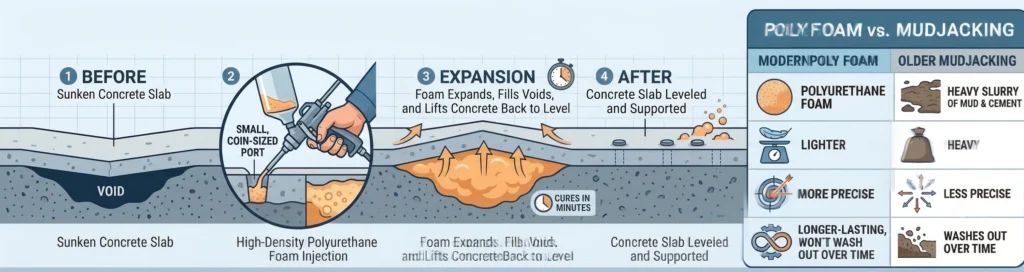
Poly foam repair, sometimes called polyjacking, involves injecting a high-density polyurethane foam beneath a concrete slab through small, coin-sized ports. The foam expands, fills the voids, and lifts the concrete back to level. It cures in minutes.
It’s the modern replacement for mudjacking (the older method that pumps a heavy slurry of mud and cement under slabs). Poly foam is lighter, more precise, longer-lasting, and doesn’t wash out over time.
Poly foam is best for:
- Concrete slabs that have sunk due to soil voids
- Driveways, patios, and pool decks
- Sidewalks and walkways
- Garage floors
- Light-load surfaces where the concrete has settled but isn’t carrying major structural weight
What Are Piers?
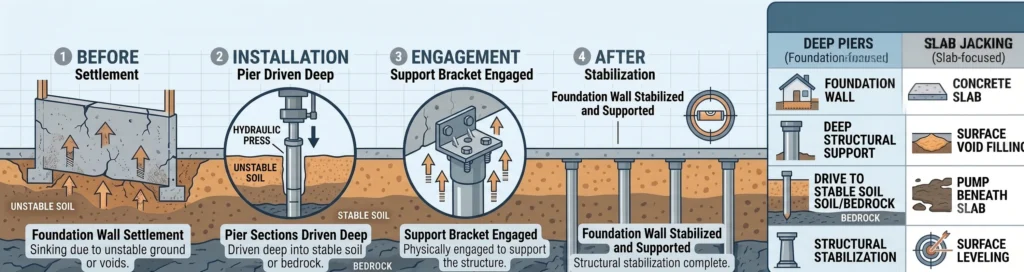
Piers address settlement at the structural level. Instead of filling voids under a slab, piers are driven or installed deep into stable soil (or bedrock) to physically support and stabilize the foundation of a building.
At G.L. Hunt Foundation Repair, that includes Concrete Piers, Steel Piers, Steel Hybrid Piers, and TexJack.
Piers are best for:
- A house or building that is settling unevenly
- Foundations sinking because the soil beneath can no longer support the load
- Structural cracks in walls, ceilings, or the foundation itself
- Doors and windows that stick or won’t close
- Heavy loads that require deep, permanent support
Poly Foam vs. Piers: Side-by-Side
The Honest Tradeoffs
The biggest mistake homeowners make is assuming the cheaper option is always the smarter one. It isn’t.
Poly foam is fast, clean, and cost-effective, but it is not a structural solution. If your home is settling because the soil deep beneath it is shifting (a very real issue across Texas clay soils), foam alone won’t hold it. You’d be treating a symptom, not the cause.
Piers cost more and take longer, but they solve structural settlement permanently by transferring the load to stable ground. Using them on a sunken patio, though, is like using a sledgehammer to hang a picture.
The right call depends entirely on what’s moving and why.
Decision Tree: Which One Do You Likely Need?
Walk through these questions in order.
Start Here
- Is the problem with a slab of flat concrete (driveway, sidewalk, patio, garage floor)?
- Yes → You’re likely a poly foam candidate. Go to Question 2.
- No, it’s my home’s foundation → Skip to Question 3.
- Is the concrete simply sunken or uneven, with no cracks in the walls of any structure it supports?
- Yes → Poly foam is very likely your solution.
- There are structural cracks nearby → Get an assessment; you may need more than foam.
- Are you seeing signs like sticking doors, cracks running through interior walls, sloping floors, or gaps around window frames?
- Yes → This points to structural settlement. Piers are likely the right call.
- No, just a sinking slab attached to the house → An assessment will confirm whether foam, piers, or both are needed.
When You Might Need Both
Some properties need a combination. For example, piers to stabilize the structural foundation, plus poly foam to fill the voids left behind or to level attached flatwork. This is common and often the most complete fix.
Not Sure Which You Need? Get a Free Assessment
Most homeowners can’t tell from the surface whether they’re dealing with a simple void under a slab or deeper structural settlement, and that’s exactly what a professional evaluation is for. G.L. Hunt will inspect your foundation, identify the real cause, and recommend only what your home actually needs, whether that’s poly foam, piers, or a combination.
No pressure, no guesswork. Just a clear answer.
Call (817) 290-9622 or request your free foundation assessment today.
FAQ
What’s the difference between polyjacking and mudjacking?
Both lift sunken concrete, but mudjacking pumps a heavy mud-and-cement slurry, while polyjacking injects lightweight polyurethane foam. Poly foam is more precise, longer-lasting, cures faster, and won’t wash out or add heavy weight to already-weak soil.
Can poly foam fix my house’s foundation?
Poly foam is designed for slabs and light-load concrete like driveways and patios. It’s not a structural repair. If your home is settling unevenly, piers are needed to transfer the load to stable soil. An assessment confirms which applies.
How do I know if I need piers instead of foam?
Watch for structural signs: sticking doors, sloping floors, and cracks running through interior walls. These point to foundation settlement requiring piers. A sinking driveway or patio with no structural cracks usually points to poly foam.
Related Articles
For more expert information about your foundation, crawl space and drainage needs, check out our helpful articles!
Common Foundation Problems
Drywall Cracks
Drywall Cracks: Foundation Problem or Normal Settling? A new crack over a doorway is hard…

Common Foundation Problems
Signs of Foundation Problems
The Hidden Damage Homeowners Miss: A Room-by-Room Walkthrough It starts small. A door that used…

Common Foundation Problems
Foundation Problems: Summer Heat and Heavy Rain
Texas summers put homes through a punishing cycle. Weeks of triple-digit heat bake the ground…