
Drainage Repair for Texas Homes: Fixing Failing Drains Outside and Under Your House
A drainage system has one job: move water away from your home before it can cause damage. When it stops working, you won’t always see it right away. A French drain clogs slowly with silt. A buried downspout line gets crushed by a truck tire or a tree root. A crawl space sump stops discharging, and water starts pooling under the floor.
In Texas, failed drainage is more than a soggy-yard problem. Our expansive clay soils swell when wet and shrink when dry, and that movement is one of the leading causes of foundation damage.
This guide covers how to spot a failing drain, what drainage repair involves, how crawl space drainage works on pier-and-beam homes, and how to tell whether you need a drainage specialist or a plumber.
Why Drainage Repair Matters for Texas Foundations
Drainage systems wear out, clog, and break like any other part of the home. When they fail, water collects against the foundation. On clay soil, that causes uneven swelling, which leads to sticking doors, cracked drywall, and gaps around windows. On pier-and-beam homes, it softens the soil under the piers and damages wood framing.
Prompt drainage repair keeps soil moisture even around the home and protects your foundation. If you’re not sure where your water problem starts, see our guide to Diagnosing and Fixing Water Drainage Problems.
5 Signs Your Yard Drain Needs Repair
A failing yard drain usually gives warning signs before it causes serious damage. Watch for:
- Standing water that lingers more than 24 hours after rain
- Soggy or spongy turf along the path of a buried drain line
- Gutters overflowing even though they’re clean, which is a sign the downspout line is backed up
- Sinkholes, depressions, or soil erosion along a pipe route
- New cracks in walls, floors, or brick near a problem area
A hose test is one of the easiest ways to check a drain. Run water into the downspout or drain inlet for several minutes. If the water backs up, drains slowly or never reaches the outlet, the line is clogged, crushed or disconnected.
Common Drainage Problems and How They’re Repaired
Clogged French Drains
Over time, clay silt and roots fill the gravel and pipe in a French drain. Light clogs can be cleared with hydro-jetting. If the drain is fully silted in, it has to be rebuilt with new gravel, fabric and pipe. Learn more on our French drains service page.
Crushed or Collapsed Drain Pipes
Thin corrugated pipe crushes easily and traps debris. Drain pipe repair means replacing damaged sections with sturdier smooth-wall pipe that has the right slope.
Downspout Lines and Other Buried Drains
A blocked downspout line dumps roof runoff at the foundation. To fix it, the line is cleared, broken connections and stuck emitters are replaced, and the discharge point is moved farther from the home.
Grading and Outlet Problems
Sometimes the pipe works fine, but the water has nowhere to go. Regrading the yard, lowering the outlet or adding a catch basin gets water moving away from the house again.
Crawl Space Drainage Systems for Pier-and-Beam Homes
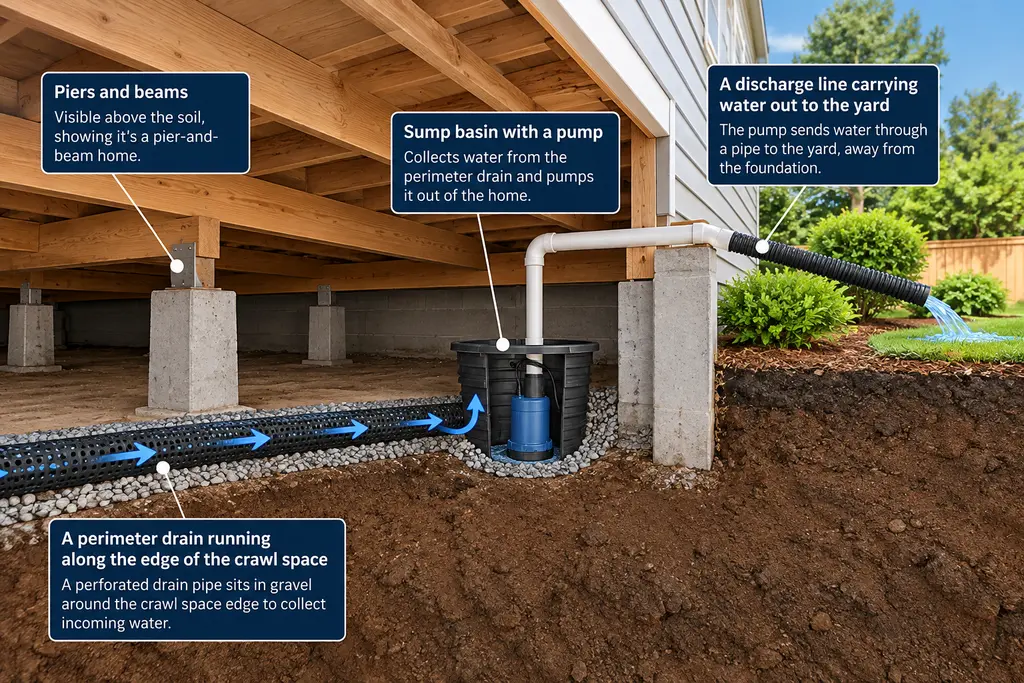
Pier-and-beam homes raise the living space above a crawl space, which makes them especially sensitive to water. When moisture gets under the house, it can soften soil around piers, rot wood beams and joists, and invite mold and pests. Read more in our post on “How Serious Is Water in a Crawl Space?”
A crawl space drainage system usually has three working parts.
Perimeter Drains
A perimeter drain runs along the inside or outside edge of the crawl space to intercept groundwater before it spreads across the soil under the home. Like any French drain, it can silt up, get crushed, or lose its slope. Signs of trouble include water collecting along the foundation walls and damp soil that never dries out.
Sump Pump and Sump Discharge
Perimeter drains often feed into a sump basin, where a sump pump pushes the water out and away from the house. A crawl space drainage system is only as good as its discharge. If the discharge line is clogged, frozen, disconnected, or empties too close to the foundation, the water simply cycles back under the home.
Common repairs include replacing a failed pump, adding a check valve, clearing or rerouting the discharge line, and extending the outlet to a safe location.
Standing Water in the Crawl Space
Standing water under a pier-and-beam home is a clear sign that crawl space drainage isn’t keeping up. It may come from surface runoff, a high water table, a failed perimeter drain, or a plumbing leak.
The fix starts with finding the source. From there, repairs might include restoring the drains, regrading the yard, correcting downspout discharge, adding a sump, or installing a vapor barrier or full encapsulation.
When to Call Drain Specialists vs. a Plumber
Not every drain problem is a drainage problem. Before searching for clogged drain repair near me, it helps to know which kind of drain you’re dealing with.
These are signs of a clog or break in your home’s wastewater lines or sewer line, and a licensed plumber is the right call.
One important overlap: a leaking supply or drain line under a slab or in a crawl space can saturate the soil and cause foundation movement. If a plumber finds a leak under your home, it’s smart to have your foundation evaluated afterward.
Get a Drainage Repair Inspection
If you’re seeing standing water, overflowing downspouts, or moisture under your pier-and-beam home, don’t wait for the next storm to make it worse.
Contact G.L. Hunt Foundation Repair to schedule an inspection and get a clear plan for drainage repair that protects your foundation.
FAQ
Can plumbers do drainage?
Plumbers handle drains inside the home and the sewer line, like sinks, toilets, and main line clogs. Yard and foundation drainage, such as French drains, downspout lines, grading, and crawl space drainage, is usually handled by drainage specialists who understand how water affects soil and foundations.
Do the sink and toilet go to the same drain?
In most homes, yes, eventually. Sinks and toilets use separate branch lines, but those lines connect to the main drain stack and building sewer. That’s why a main line clog can back up several fixtures at once, while a single slow sink usually points to a local clog.
What are the five types of drainage?
Residential drainage is commonly grouped into five types: surface drainage, subsurface drainage, slope drainage, downspout and gutter systems, and French drains. Many Texas homes use a combination, especially on clay soils, where moving water away from the foundation is essential to preventing soil movement.
Is professional drain cleaning worth it?
Usually, yes. Professionals use hydro-jetting and camera inspections to clear the full blockage and find its cause, such as roots, silt, or a crushed pipe. DIY fixes often only clear part of the clog, so the problem returns, and hidden damage keeps growing.
Related Articles
For more expert information about your foundation, crawl space and drainage needs, check out our helpful articles!
Drainage & Gutters
Drainage Contractor in Texas
Drainage Contractor in Texas: Protecting Your Foundation From the Ground Up Every drainage contractor in…
Drainage & Gutters
Sump Pump Installation
Standing water in your yard could mean foundation trouble ahead. Here's how sump pumps work,…
Drainage & Gutters
French Drain vs Surface Drain
French Drain vs. Surface Drain: Which One Does Your Yard Actually Need? If your yard…