Foundation Damage From Weather
If you live in Dallas, you know the saying: “If you don’t like the weather, just wait five minutes.” Our weather is famous for its extreme swings. We have scorching summers, sudden spring floods and icy winter storms.
While this weather is tough on us, it’s even tougher on your home. Specifically, it affects the concrete slab your house sits on. Many homeowners are surprised to learn that the ground under their feet is the leading cause of slab foundation issues.
That’s why our foundation repair experts at G.L. Hunt Foundation Repair have written this guide to explain the common question: how does weather affect concrete slab foundation stability, and what you can do to stop it.
Quick Facts
- Expansive clay soil — Most Dallas homes are built on clay soil that acts like a sponge—swelling when wet and shrinking when dry.
- Summer shrinkage — High heat dries out the soil, causing it to pull away from the foundation. This settlement leads to common slab foundation issues.
- Rainy season — Heavy rains cause the soil to expand rapidly, pushing the concrete slab upward and stressing the structure.
- Winter risks — Freeze-thaw cycles can turn minor hairline fractures into larger foundation cracks.
- Prevention — Maintaining consistent soil moisture with soaker hoses and proper drainage is the best way to prevent concrete slab foundation issues.
The Real Culprit: Dallas Clay Soil
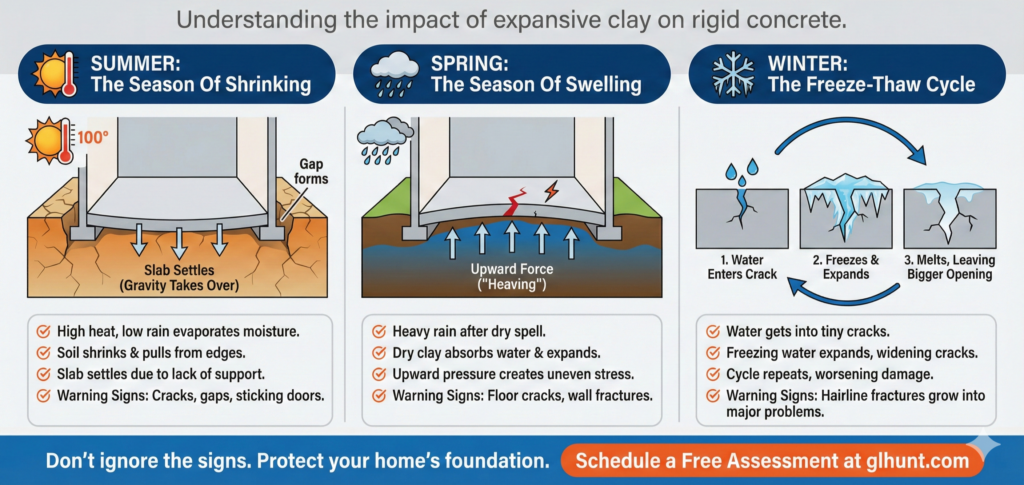
To understand why the weather matters, you first need to understand the dirt. Most of Dallas and North Texas is built on expansive clay soil. This soil reacts to dryness and moisture much like a sponge, swelling when wet and shrinking when dry.
This constant motion is bad news for concrete. Concrete is strong, but it’s rigid. It can’t stretch or bend. When the soil below it moves, the concrete has no choice but to crack.
Summer: The Season Of Shrinking
Summer is often the most dangerous time for your foundation. When we go weeks without rain, and temperatures hit 100 degrees, the moisture in the ground evaporates.
As the soil dries out, it shrinks, and it pulls away from the edges of your foundation. This creates a gap between the dirt and the concrete. Suddenly, the edges of your home are floating in the air instead of resting on solid ground.
Gravity takes over, and the slab settles downward. This is when you start seeing concrete slab foundation issues like cracks, gaps and doors that won’t latch are the early warning signs.
Spring: The Season of Swelling
After a dry winter or summer, spring storms bring heavy rain. You might think this is good for the dry soil, but it can actually cause “heaving.”
The dry clay instantly absorbs water and expands with great force. This expansion pushes upward against your slab. If one part of your house is pushed up while another stays still, it creates stress. This pressure often leads to cracks in your living room floor or on the walls.
Winter: The Freeze-Thaw Cycle
We don’t get snow often, but we do get ice. When water gets into tiny cracks in your concrete or the soil around it and then freezes, it expands.
This is called the “freeze-thaw cycle.”
- Water enters a small crack.
- The water freezes and expands, widening the crack.
- The ice melts, leaving a bigger opening for more water next time.
Over time, this cycle can turn a hairline fracture into a major structural problem.
Signs Your Slab Is Struggling
How do you know if the weather has already damaged your home? Your house will try to tell you. Look for these warning signs:
- Sticking doors — If a door that used to open easily now gets stuck, your frame has shifted.
- Window gaps — Look for separation between the window frame and the brick.
- Floor cracks — Remove carpets or check tiles for long cracks running across the room.
- Uneven floors — If you put a ball on the floor, does it roll to one side?
How To Protect Your Slab
You can’t change the weather, but you can manage how it hits your home. The goal is consistency. You want to keep the moisture level under your home as steady as possible.
1. Water Your Foundation
In the summer, don’t just water your lawn — water your house. Use a “soaker hose” placed about 18 inches away from your foundation. Run it during dry spells to keep the soil from shrinking too much.
2. Fix Your Drainage
When it rains, you need that water to move away from your house, not pool next to it. There are three simple ways to fix your drainage! Ensure your gutters are clean, extend downspouts and check that your yard slopes away from the foundation.
Get A Professional Opinion
If you’re seeing cracks or are worried about the next big storm, don’t guess. Concrete slab foundation issues get more expensive the longer you ignore them.
At G.L. Hunt, we have spent decades fixing homes in Dallas. We know how this weather works and how to secure your home against it.
Would you like to schedule a free foundation evaluation to see if the Dallas weather has affected your home?
Related Articles
For more expert information about your foundation, crawl space and drainage needs, check out our helpful articles!

Common Foundation Problems
Do Houses On Hills Have Foundation Problems?
Quick Summary: Hillside Foundation Risks Hillside Homes Can Use Some Extra Attention Living in a…
Common Foundation Problems
How Do Expansive Soils In Dallas Affect My Foundation?
If you live in North Texas, you’ve probably noticed large cracks in the ground during…

Common Foundation Problems
Common Foundation Problems In Austin, Texas
Austin Foundation Company The foundation of your home is its most important structural component. It…