Quick Summary: Hillside Foundation Risks
- Gravity and soil creep — Soil naturally moves downhill over time, exerting pressure on foundations.
- Water runoff — Rainwater flows faster on slopes, leading to erosion and washing away supporting soil.
- Differential settlement — One part of the house may settle faster than the other due to uneven soil depths.
- Foundation types — Hillside homes often use deep piers or step-down designs to combat instability.
Hillside Homes Can Use Some Extra Attention
Living in a home with a scenic overlook is a dream for many homeowners. However, the geology that provides those beautiful views can also put significant stress on your home’s structure.
At G.L. Hunt, we understand that while hillside homes offer unique beauty, they also face challenges that differ from those of houses built on flat ground. If you’re noticing cracks or uneven floors in your hillside property, understanding the science behind your foundation is the first step toward fixing it.
The Unique Challenges Of Homes On A Slope
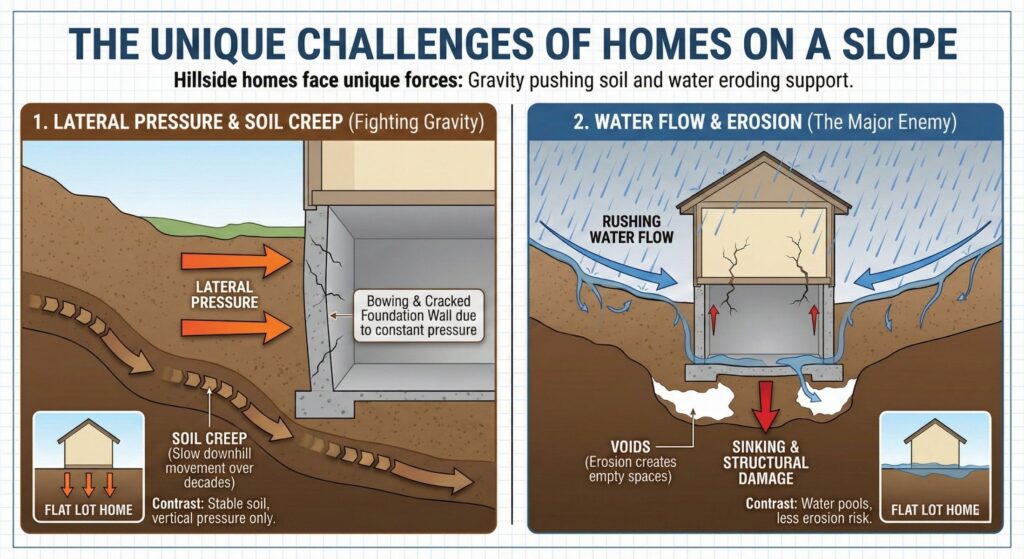
Building homes on a slope requires fighting against gravity. Unlike a house on a flat lot, a hillside home is constantly subjected to lateral (sideways) pressure. The soil on a hill is not static. It slowly moves downhill in a process called soil creep. While this movement is usually too slow to be seen with the naked eye, over the years or decades, it can push against foundation walls, causing them to bow or crack.
Additionally, water is a major enemy. On a flat lot, water might pool, but on a hill, it flows. If the built hillside foundation design doesn’t account for proper drainage, rushing water can erode the soil under the foundation footing. This erosion creates voids, leaving the concrete without support, leading to sinking and structural damage.
Houses On A Hillside: Signs Of Trouble
Because of the extra stress, houses built on a hillside or slope often show signs of foundation distress earlier than other homes. You should look out for:
- Diagonal cracks — Large cracks in drywall, especially around door frames and windows.
- Sticking doors — If the house twists as it settles, door frames become uneven, causing doors to jam.
- Uneven floors — If you feel like you’re walking uphill or downhill inside a room, the foundation has likely shifted.
- Separation — Gaps appearing between the wall and the ceiling, or between a chimney and the siding.
Solutions For Hillside Foundations
If you own a home on an incline, you aren’t destined to have problems, but you do need to be vigilant.
- Drainage is key — Ensure gutters direct water well away from the house. You may need French drains or retaining walls to control water flow around your property.
- Foundation repair — If settlement has occurred, companies like G.L. Hunt can install steel piers or concrete pilings. These underpin the home, transferring the weight of the house off the unstable, shifting soil and onto deeper, load-bearing strata.
Hillside living is wonderful, but it requires a solid base. By keeping an eye on drainage and cracks, you can ensure your home stays safe and level for years to come.
Secure Your Hillside Home With GL Hunt
Don’t let the fear of a slipping foundation keep you up at night. Hillside homes are beautiful, but they require expert care to stay safe. If you’ve noticed any of the warning signs mentioned above, it’s time to call in the professionals.
At G.L. Hunt, we specialize in the complex repair techniques required for homes on a slope. We don’t just patch the cracks or do quick fixes. We solve the underlying structural issues to keep your home safe. Contact us today to schedule your free estimate!
Related Articles
For more expert information about your foundation, crawl space and drainage needs, check out our helpful articles!
Common Foundation Problems
How Do Expansive Soils In Dallas Affect My Foundation?
If you live in North Texas, you’ve probably noticed large cracks in the ground during…
Common Foundation Problems
How Does Dallas Weather Affect My Concrete Slab?
Foundation Damage From Weather If you live in Dallas, you know the saying: “If you…

Common Foundation Problems
Common Foundation Problems In Austin, Texas
Austin Foundation Company The foundation of your home is its most important structural component. It…